
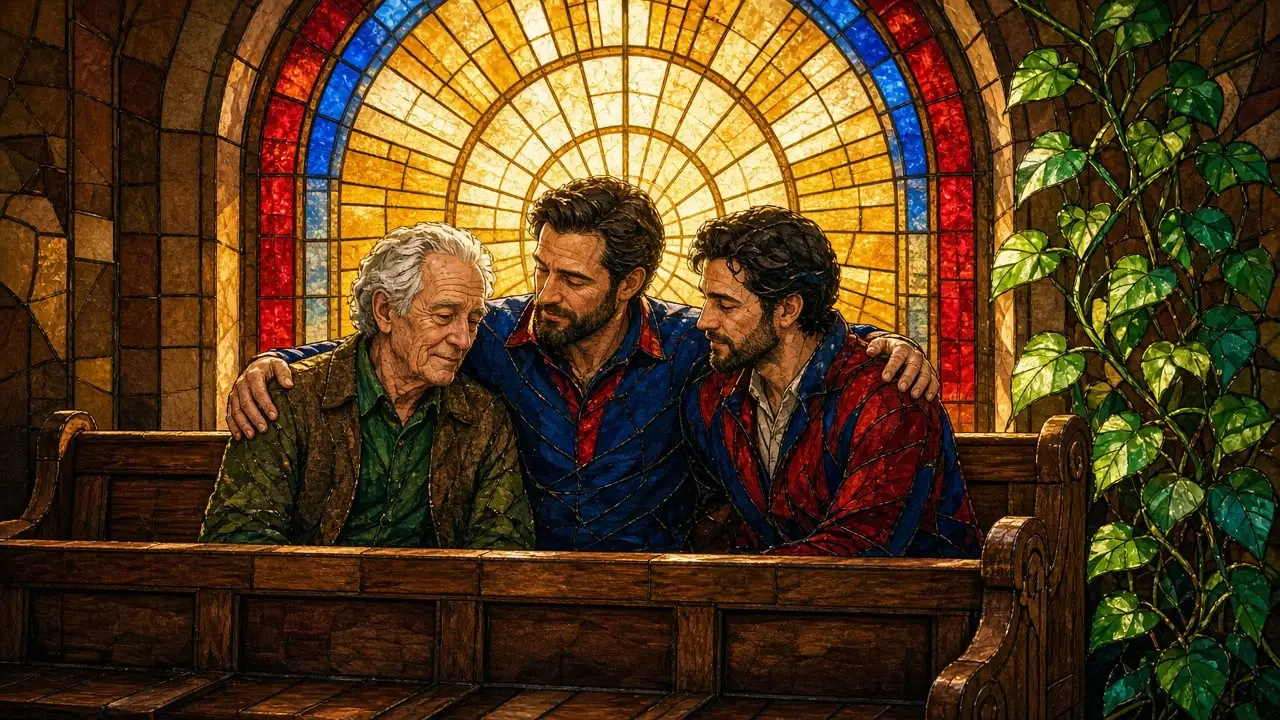
 The holidays are coming. For some of us, that means warm kitchens and full tables. For others, it means a knot in the stomach, because the people around that table are the same people who hurt us, or who we hurt.
Pastor Nick at Church by the Glades opened his sermon this Sunday by naming exactly that: “For others of us, the holiday season is simply a reminder maybe of what you never had.” He didn’t stop there. His message was about the patterns families pass down, and the moment someone decides they won’t pass them on.
I’ve spent over 40 years in human services, and this is one of the most important conversations we can have in recovery. So let’s have it.
Every family has some dysfunction
Nick put it plainly: all of us “have a degree of dysfunction in our family,” because families “are made up of flawed, broken, sinful, and dysfunctional individuals.” That’s not an insult. It’s the human condition. Nobody gets a perfect family, and nobody gets to be a perfect parent.
He also pointed out something that surprises many people. “The Bible is not full of perfect people.” It’s full of messy, imperfect people who were still loved and still used by God. In Nick’s words, Abraham, Isaac, Jacob, and Joseph were “a very beautiful, powerful, godly, but very broken family.”
If that’s true of the people in Scripture, it’s okay if it’s true of us. The point isn’t to pretend we’re fine. The point is to look honestly at what we inherited.
How patterns travel down the generations
Nick walked through the story of Abraham lying about his wife, Sarah, to protect himself. Years later, his son Isaac found himself in almost the same situation and did the same thing. Nick imagined Isaac thinking, “Well, my dad did it. So it must be an option for me to do as well.” Then Jacob deceived his father, and Jacob’s sons deceived him about Joseph. Same lie, new generation.
That’s how generational trauma tends to work in real families too. It rarely announces itself. It shows up in how we argue, how we shut down, and how we handle money, stress, or grief. And very often it shows up in the bottle or the pill. Nick even voiced what so many people tell themselves: “This is just how my family is. We’re angry, we get anxious… we lie, we drink.”
The painful part came next: “We end up repeating and replicating the very behavior we hated to begin with just because it was modeled for us.”
If you grew up with addiction in the house, you probably promised yourself you’d never be like that. And then one day you heard your parent’s voice come out of your own mouth. That’s not proof you’re doomed. It proves the pattern is real, and that changing it takes intention.
Our kids are watching
This part of the sermon hit me hardest. Nick said, “Your kids are not just listening to what you say. They’re watching what you do. They’re watching how you love your wife. They’re watching how you serve your neighbors.”
Then he got specific: “Allow your children to hear you say I’m sorry when you’ve done something wrong and allow them to hear you forgive when you have been wronged.”
Think about that in recovery terms. A lot of us grew up in homes where nobody ever apologized. People hid mistakes, denied them, or blamed someone else. When a child hears a parent say “I’m sorry, I was wrong,” something shifts. They learn that you can mess up and still be loved. They learn that repair is possible.
Saying “I love you” matters. Showing it matters more. Love that kids can see looks like keeping promises, showing up sober, staying calm when you used to explode, and owning it when you don’t. As Nick put it, “it could be the difference between future generations being blessed and future generations carrying a burden.”
An example is neutral
One line I keep coming back to: “An example is neutral.” Nick explained that the example “may have been set for you, but what you do with the example is up to you.” You can treat what you saw growing up “as something to reproduce and replicate” or as “something to resist and reject.”
He also drew a helpful line “between events and decisions.” What happened to you was an event. You didn’t choose it. But what you do now is a decision. In his words, “The offense, that’s an event. But the unforgiveness you’ve been harboring in your heart, that’s a decision.”
That’s not about blaming anyone who’s hurting. Trauma is real, and its effects on the brain and body are real. It’s about hope. “Just because what happened to you was bad does not mean you have to continue to live bound by what happened to you.” Nick’s advice was to let your past “inform you of what not to do. And then learn a new set of behaviors.”
Learning new behaviors is exactly what recovery is. It’s also why counseling, trauma-informed therapy, and family therapy can be so helpful. You don’t have to figure out a new way of living all alone.
A family that’s dealing with opioids needs a different first step
I want to be careful here, because breaking the cycle can sound like “cut them off” or “let them hit bottom.” With alcohol and many other drugs, setting firm boundaries is often healthy. With opioids like heroin and fentanyl, the first goal is keeping your loved one alive. One bad batch can end a life before anyone gets a second chance.
- Keep naloxone (Narcan) at home and in the car, and learn how to use it. Many pharmacies sell it without a prescription.
- If someone is unresponsive or not breathing well, call 911 right away and give naloxone.
- Talk with an addiction professional before making big decisions about boundaries, money, or housing, so your plan protects your family without putting your loved one at greater risk.
- For free, confidential help finding treatment, call the SAMHSA National Helpline at 1-800-662-4357, 24 hours a day.
- If you or your loved one is in crisis or having thoughts of suicide, call or text 988 (Suicide & Crisis Lifeline).
If you’re walking this road with someone you love, my post Loving Someone Who’s Still Using goes deeper on how to care for them and for yourself.
It can stop with you
Nick closed with the story of Joseph, the brother who was betrayed and sold into slavery by his own family. Years later, Joseph had the power to get even. Instead, he said to his brothers, “You intended to harm me, but God intended it for good to accomplish what is now being done, the saving of many lives” (Genesis 50:20, NIV).
Joseph didn’t pretend the harm never happened. He named it. And then he refused to let it be the end of the story.
Nick gave us a sentence worth saying out loud: “I’m going to break the chain for my family, for my kids, for people who will never know my name, for future generations.” And then this: “It may have run in your family, that is, until it ran into you.”
Maybe you can’t fix everything your family went through. Most of us can’t. But you can slow the harm. You can be the first one to say “I’m sorry.” You can be the one who gets help, who keeps the naloxone handy, who forgives, who stays. That’s how a family history starts to change. One person and one decision at a time.
As Nick put it, “Or you could heal. You could get better. You could grow. You could learn. And you can even use the things that you have gone through to inspire other people.”
So here’s my question for you: what’s one pattern from your family that you want to stop with you, and what’s one small thing you can do this week to start?
Go, Go, Go… Dan 🙂
Watch Pastor Nick’s full message at Church by the Glades: Church by the Glades livestream, November 1, 2026.
If you love someone who’s struggling with addiction, subscribe, and I’ll send you my free family guide, Love Without Losing Yourself.
Books quoted in this post:
As an Amazon Associate, I earn from qualifying purchases.
—
AI transparency: I used AI to help organize this reflection on Pastor Nick’s sermon and reviewed it before posting. Sermon quotes belong to the original source and were taken from the livestream recording.
Image created with AI assistance.