
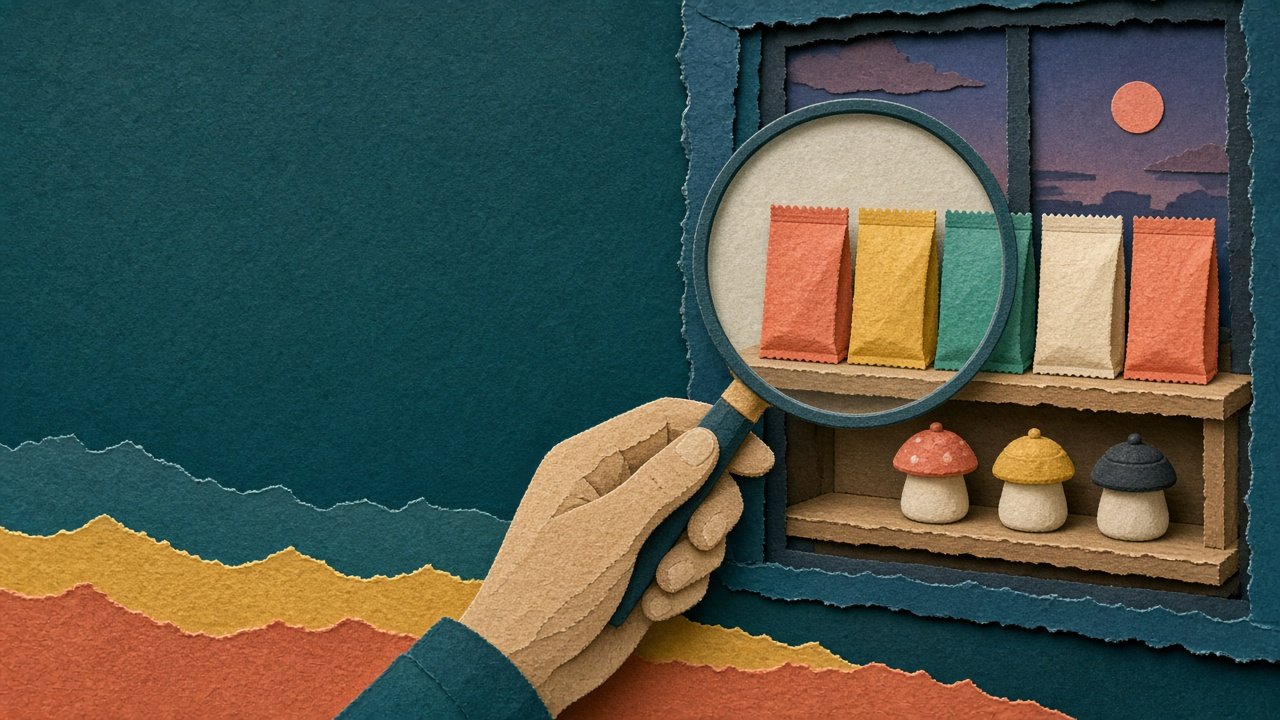
You’ve probably seen them. Bright little packages of gummies, vapes, and chocolate bars in the window of the smoke shop next to the gas station. Some say “hemp.” Some say “mushroom.” A lot of them look like candy.
A new study in the Journal of Studies on Alcohol and Drugs asked a simple question: what are smoke shops actually selling when it comes to delta-8 THC and mushroom products, and does the law make a difference? The answer matters if you’re in recovery or love someone who is.
Here’s what the researchers did, what they found, what the study can’t tell us, and what it means in everyday life. No scare tactics, just the facts.
The study in a nutshell
The paper is titled “Retail Availability of Intoxicating Cannabis and Mushroom Products Across Eleven U.S. Cities: Sales Persist Despite Prohibitions.” Cassidy R. LoParco, Carla J. Berg, and colleagues at George Washington University and the University of North Texas Health Science Center wrote it, and it was published online on May 29, 2026.
Between May and October 2025, the team searched Google for smoke shops in eleven cities in California, Colorado, Florida, Maryland, New York, Nevada, Oregon, Pennsylvania, Texas, Virginia, and Washington. Then they did something wonderfully old-fashioned. They picked up the phone and called every shop, 1,023 in all, to ask what was on the shelves.
They didn’t pick those states at random. Their laws differ. Seven of them explicitly ban the sale of the hemp-based THC products the study looked at. Two have decriminalized psilocybin. None explicitly outlaws Amanita mushrooms.
A few terms, in plain English
- Delta-8 THC and other “derived” cannabis products. The researchers call these DICPs, short for “derived intoxicating cannabis products.” Think gummies, vapes, and drinks, usually made from hemp. The FDA says delta-8 THC “has psychoactive and intoxicating effects, similar to delta-9 THC,” which is the part of marijuana that causes a high. So “hemp” on the label doesn’t mean it won’t get you high.
- Psilocybin. The hallucinogen in so-called “magic mushrooms.”
- Amanita muscaria. A different mushroom, the red one with white spots you’ve seen in fairy-tale pictures. It contains other mind-altering compounds (muscimol and ibotenic acid). In December 2024, the FDA said Amanita and those compounds aren’t authorized as food ingredients and recommended people avoid foods that contain them.
What the researchers found
- About half the shops sold hemp THC products. Of the 747 shops that answered questions about them, 51.4% said they sold them.
- Bans helped, but only partly. In states where these products are explicitly illegal, 39.6% of responding shops still sold them, compared with 80% in states where they aren’t explicitly illegal. That’s a real, statistically meaningful difference. Still, four in ten shops sell something their state has banned.
- Where you live matters. Sales ranged from 2.0% of shops in New York City to 93.8% in Jacksonville, Florida.
- Mushroom products were even more common. Of the 718 shops that answered questions about mushrooms, 59.7% sold them. Decriminalizing psilocybin made no real difference (56.6% in those states versus 57.9% where psilocybin is illegal).
- Many sellers didn’t know what they were selling. Among the shops selling mushroom products, 54.1% said they sold Amanita, 17.4% said “something else,” and more than a quarter (28.5%) didn’t know what type of mushroom it was.
The authors conclude that these cannabis products “were sold widely, including in states where they were expressly illegal,” and that the findings “suggest the need for greater retail surveillance, education, and enforcement.”
What the study can’t tell us
Good research is honest about its limits, and two matter most here.
- It measured what shops said on the phone. The researchers didn’t buy or lab-test anything, and the study doesn’t measure who uses these products or whether anyone was harmed.
- Not every shop answered. About 27% of shops didn’t respond about the THC products, and about 30% didn’t respond about mushrooms. The shops that stayed quiet might be different from the ones that talked.
It also covers eleven cities, not the whole country. So think of it as a careful snapshot, not the final word.
The law is changing, and it’s confusing
Federal law is in flux. In November 2025, Congress rewrote the legal definition of hemp, including a limit of 0.4 milligrams of total THC per container for finished hemp products. According to the Congressional Research Service, one piece of that change takes effect November 12, 2026, and most of the rest was pushed back to December 11, 2026. States have their own rules on top of that.
If the rules feel like a moving target, that’s because they are. And as this study shows, a law on the books doesn’t guarantee what’s on the shelf.
What this means for people in recovery
After more than 40 years in human services, here’s what I know: when something is sold openly, right next to the energy drinks and lighters, it’s easy to tell yourself it’s no big deal. “It’s legal.” “It’s just hemp.” “It’s only a mushroom gummy.” That kind of thinking can sneak up on anyone, especially early in recovery.
This study gives us a few practical reminders.
- “Sold in a store” doesn’t mean “safe” or even “legal.” Four in ten responding shops in states with a ban were still selling hemp THC products.
- The label may not tell the whole story. If more than a quarter of mushroom sellers couldn’t name what they sold, the buyer probably can’t either. A 2024 CDC report from Virginia described mushroom gummies sold at gas stations and smoke shops; lab tests found psilocybin in some, and one contained mitragynine, the main compound in kratom.
- Intoxicating is intoxicating. If your recovery plan is to stay free of mind-altering substances, these products are part of that plan too, whatever the package says.
- Reach out before you walk in. If you feel the pull, call someone in your support network first. Feelings aren’t facts, and a craving passes when you don’t feed it.
What families and loved ones can do
- Know what these products look like. Back in 2011, I wrote about “Canna Cola,” a marijuana soda whose flavors copied popular soft drinks. Today, the Congressional Research Service notes that some hemp THC products come in packaging that looks like familiar snack food brands.
- Ask, don’t accuse. If you find a gummy or a vape, a calm question like “What is this, and where did you get it?” usually goes further than a lecture. Love and honesty open more doors than fear does.
- Store things safely. The FDA says delta-8 THC products should be kept out of reach of children and pets.
- Know who to call. For an emergency, call 911. Poison Help (1-800-222-1222) is free and confidential, and available 24 hours a day. For treatment referrals, SAMHSA’s National Helpline (1-800-662-4357) is free, confidential, and open 24/7.
This post is for general information. It isn’t medical or legal advice, so please talk with a doctor or other qualified professional about your own situation.
Eyes open, not afraid
Scripture says it well: “The prudent sees danger and hides himself, but the simple go on and suffer for it.” (Proverbs 22:3, ESV) Being prudent isn’t living in fear. It’s knowing what’s out there and choosing your path with your eyes open. God gives us the wisdom to do exactly that.
None of this is meant to scare you. It’s meant to help you see the shelf clearly. As I wrote in Success-Full, Living Life with Purpose: Recovery Mode, “It is much easier to stay sober than it is to get sober.” Knowing what’s being sold down the street is one more way to protect the good life you’re building. Life is GOOOOOOOD!!!
So here’s my question for you: Have you noticed these products in your neighborhood, and what’s one step you’ll take to protect your recovery, or a loved one’s?
Go, Go, Go… Dan 🙂
Sources:
- LoParco CR, Rossheim ME, Tillett KK, Cui Y, Johnson M, Speer M, Mihelich D, Amdeta H, Ndisebuye D, Berg CJ. “Retail Availability of Intoxicating Cannabis and Mushroom Products Across Eleven U.S. Cities: Sales Persist Despite Prohibitions.” Journal of Studies on Alcohol and Drugs, published online May 29, 2026. https://doi.org/10.15288/jsad.26-00013
- U.S. Food and Drug Administration. “5 Things to Know about Delta-8 Tetrahydrocannabinol (Delta-8 THC).” https://www.fda.gov/consumers/consumer-updates/5-things-know-about-delta-8-tetrahydrocannabinol-delta-8-thc
- U.S. Food and Drug Administration. “FDA Alerts Industry and Consumers about the Use of Amanita Muscaria or its Constituents in Food.” December 18, 2024. https://www.fda.gov/food/hfp-constituent-updates/fda-alerts-industry-and-consumers-about-use-amanita-muscaria-or-its-constituents-food
- Centers for Disease Control and Prevention. “Notes from the Field: Schedule I Substances Identified in Nootropic Gummies Containing Amanita muscaria or Other Mushrooms, Charlottesville, Virginia, 2023 to 2024.” MMWR, 2024. https://www.cdc.gov/mmwr/volumes/73/wr/mm7328a3.htm
- Congressional Research Service. “Changes to the Statutory Definition of Hemp and Implications for Agricultural Policy” (IF13136), updated September 28, 2026. https://www.congress.gov/crs-product/IF13136
Books quoted in this post:
As an Amazon Associate, I earn from qualifying purchases.
—
AI transparency: I used AI to condense this from the cited research and reviewed it before posting. Facts and quotes belong to the original sources.
Image created with AI assistance.