
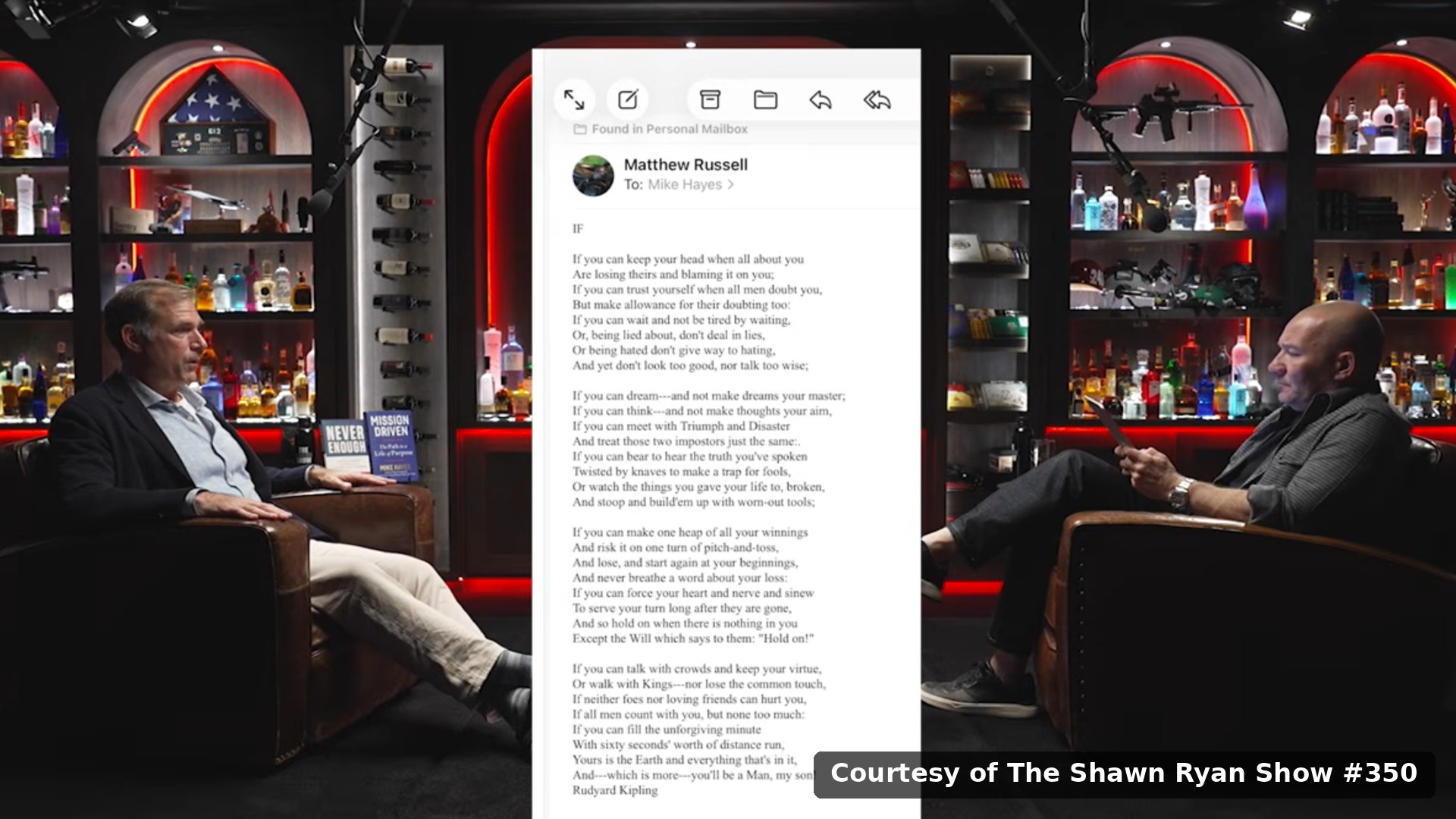
 Retired Navy SEAL commander Mike Hayes told a story on The Shawn Ryan Show, episode #350, that gave me chills. It’s about a poem his grandfather taught him: Rudyard Kipling’s “If.”
Hayes says his grandfather’s own dad had made him memorize the poem as a little boy, and his grandfather passed it on to Mike. “It’s called If by Rudyard Kipling,” Hayes said. He calls “what does it mean to be a man” “the essence of the poem,” and then he puts it in his own words: “can you hang out with kings and can you hang out with plumbers?”
Years later, Hayes was carrying what he called “such extreme stress and pressure” during his time in Afghanistan, and he says he didn’t talk much about this kind of stuff with his teammates. He logged on to his computer and found an email from his buddy Rocky, his XO, dated June 7, 2012. Rocky didn’t write a word. He just copied and pasted the poem “If” and sent it, “without knowing its significance at all to me,” Hayes said. Then he told Shawn, “That was an email from my grandfather in heaven.” He added, “In many ways, my grandfather is my guardian angel.”
I love that story. Truly a Godincidence, not a coincidence. Sometimes the right words show up right on time, through the people God puts in our lives. Rocky didn’t know the history. He just knew it was a great poem, and he passed it on. You never know who needs the encouragement you share today.
Watch Hayes tell it on YouTube (starts at 3:32:20), or find the full episode on Spotify, Vigilance Elite, and Patreon.
Kipling’s “If” for recovery
Rocky’s email reached Hayes at one of the hardest times of his life, and the same poem can meet us in our hard times too. Some poems you read once and forget. Others stay with you for the rest of your life, and “If” is one of the second kind.
The poem is written as a father’s advice to his son, and it was first published in 1910 in Kipling’s book Rewards and Fairies. More than a hundred years later, two of its lines are inscribed above the players’ entrance to Centre Court at Wimbledon. Not bad for a poem that’s really just one long sentence!
Here’s why I love it for recovery. Almost every line offers a short lesson in staying steady when life pushes back. Read it slowly first. Then let’s walk through it together, one “If” at a time, in plain English.
If
by Rudyard KiplingIf you can keep your head when all about you
Are losing theirs and blaming it on you;
If you can trust yourself when all men doubt you,
But make allowance for their doubting too;
If you can wait and not be tired by waiting,
Or being lied about, don’t deal in lies,
Or being hated, don’t give way to hating,
And yet don’t look too good, nor talk too wise;If you can dream—and not make dreams your master;
If you can think—and not make thoughts your aim,
If you can meet with Triumph and Disaster
And treat those two impostors just the same;
If you can bear to hear the truth you’ve spoken
Twisted by knaves to make a trap for fools,
Or watch the things you gave your life to, broken,
And stoop and build ’em up with worn-out tools;If you can make one heap of all your winnings
And risk it on one turn of pitch-and-toss,
And lose, and start again at your beginnings
And never breathe a word about your loss;
If you can force your heart and nerve and sinew
To serve your turn long after they are gone,
And so hold on when there is nothing in you
Except the Will which says to them: ‘Hold on!’If you can talk with crowds and keep your virtue,
Or walk with Kings—nor lose the common touch,
If neither foes nor loving friends can hurt you,
If all men count with you, but none too much;
If you can fill the unforgiving minute
With sixty seconds’ worth of distance run,
Yours is the Earth and everything that’s in it,
And—which is more—you’ll be a Man, my son!
Text as printed in Rewards and Fairies (1910), via Project Gutenberg. The poem is in the public domain.
Stanza one: staying steady when people push on you
“If you can keep your head when all about you / Are losing theirs and blaming it on you.” Picture a holiday dinner. Somebody brings up the old days, voices get loud, and suddenly it’s your fault the turkey is dry. Keeping your head doesn’t mean you don’t feel anything. It means you take a breath, maybe step outside, and you don’t pour fuel on the fire. You can’t control the room. You can control you.
“If you can trust yourself when all men doubt you, / But make allowance for their doubting too.” In early recovery, many people may doubt you, and some have good reasons. Maybe they’ve heard “this time is different” before. Trust yourself enough to keep showing up, and give them room to wait and see. Trust usually comes back slowly, through kept promises, not big speeches.
“If you can wait and not be tired by waiting.” Waiting for the court date. Waiting for your kids to call back. Waiting for your head to clear and your sleep to come back. Waiting is hard work! I wrote about this in Easy Does It!: patience is a skill we build, not a trait we’re born with.
“Or being lied about, don’t deal in lies.” Somebody tells a story about you that isn’t true. The old reflex might be to spin a bigger story right back. Recovery asks us to be honest anyway, even when it doesn’t seem fair. The truth holds up better over time than any comeback ever will.
“Or being hated, don’t give way to hating.” Not everyone will cheer for you. Some people may even stay angry for years. Hate is heavy, and it only weighs down the one who carries it. That’s the whole idea behind Throw a Blessing Instead!
“And yet don’t look too good, nor talk too wise.” This is my favorite little twist in the first stanza. Do all those good things, but don’t get preachy about them! Nobody wants to hear a lecture from someone with ninety days. Humility keeps us teachable and likable, too.
Stanza two: dreams, thoughts, wins, and losses
“If you can dream,” and “not make dreams your master.” Dream big! But a dream that turns into an obsession can steal today. Maybe you dream of getting your license back, the new job, or a home of your own. Hold the dream loosely and do the next small thing that moves you toward it.
“If you can think,” and “not make thoughts your aim.” Thinking is good. Overthinking is a trap. Some of us can plan, analyze, and replay a problem for hours and never take one step. Thinking is the tool, not the goal. At some point you have to put the pen down and make the phone call.
“If you can meet with Triumph and Disaster / And treat those two impostors just the same.” These are the two lines over the door at Wimbledon, and they fit recovery perfectly. A big win, like a one-year sober anniversary or a promotion, can make us cocky and careless. A big loss, like a breakup or a layoff, can make us feel hopeless. Kipling calls both of them impostors. Neither one gets to tell you who you are. In Recovery Thinking, 90-Days to Change Your Life! I put it this way: “So stress and challenges are our friends.”
“If you can bear to hear the truth you’ve spoken / Twisted by knaves to make a trap for fools.” You share something honest, and somebody twists it into gossip. It stings. Let it sting, and then let it go. You don’t have to chase down every rumor to protect your recovery.
“Or watch the things you gave your life to, broken, / And stoop and build ’em up with worn-out tools.” This might be the most “recovery” line in the whole poem. Maybe it’s a marriage, your credit, your health, or your reputation. You look at the pieces, and you don’t feel like you have much to work with. Bend down and start anyway. Worn-out tools still work. One phone call, one paid bill, one honest conversation at a time.
Stanza three: starting over and holding on
“If you can make one heap of all your winnings / And risk it on one turn of pitch-and-toss.” Pitch-and-toss was an old coin-tossing gambling game. Kipling isn’t telling us to gamble! He’s talking about taking a big risk on something that matters, losing, and handling it with grace.
“And lose, and start again at your beginnings / And never breathe a word about your loss.” Starting over is part of life, and for some of us it’s part of recovery. In Success-Full, Living Life with Purpose: Recovery Mode, I wrote, “Every No brings me closer to a YES!” Here’s one place I’d gently add to Kipling, though. Not whining about a loss is good. Keeping it all bottled up is not. Talk to the people you trust: your counselor, your mentor, your mutual support group, or your pastor. Just don’t move into the loss and live there.
“If you can force your heart and nerve and sinew / To serve your turn long after they are gone.” Ever have a day where you are just done? Tired, cranky, and running on fumes? That’s the day this line was written for. You still do the basics: eat something, make the call, show up, and go to bed sober.
“And so hold on when there is nothing in you / Except the Will which says to them: ‘Hold on!'” Some nights the only thing you have left is “Hold on!” That’s enough. It really is. And you don’t have to hold on by yourself. God gives strength when ours runs out. Scripture says it so well: “And let us not grow weary of doing good, for in due season we will reap, if we do not give up.” (Galatians 6:9, ESV) Whatever you do, don’t quit before the miracle.
Stanza four: people, boundaries, and the minute in front of you
“If you can talk with crowds and keep your virtue, / Or walk with Kings,” and “nor lose the common touch.” Some of us get our lives back and then some. A good job, a nice title, or people who look up to us. Kipling’s advice is to stay the same person in a crowd, in the boardroom, and at the bus stop. Remember where you came from, and treat everybody with the same respect.
“If neither foes nor loving friends can hurt you.” This isn’t about building a wall. It’s about not handing anyone the remote control to your mood or your sobriety. Your enemies don’t get to knock you off course. Neither do the people who love you, when they’re scared or upset.
“If all men count with you, but none too much,” I call this a perfect one-line lesson on boundaries. Everybody matters. Nobody gets to be your Higher Power. People-pleasing and caretaking can wear us out and pull us off course. Love people, help people, and still keep your own recovery first.
“If you can fill the unforgiving minute / With sixty seconds’ worth of distance run.” A minute doesn’t wait for anybody. That’s why it’s “unforgiving.” But you only have to fill this one. This hour. This day. Do the next right thing with the time in front of you, and let tomorrow take care of tomorrow. And when a minute goes badly, treat setbacks as signals and move on to the next.
“Yours is the Earth and everything that’s in it.” And then the best part: “you’ll be a Man, my son!” The poem speaks to a boy, but the promise applies to all of us, sons and daughters alike. The reward isn’t fame or money. It’s becoming the person God made you to be: steady, honest, kind, and free.
You don’t have to do all of it today
Read the whole poem again, and it can feel like a lot. Nobody does every line perfectly. I sure don’t! Progress, not perfection. Pick one “If” and practice it today. Tomorrow, pick another one. Over time, these lines stop being a poem on the wall and start being how you live. Life is GOOOOOOOD!!!
So here’s my question for you: Which “If” in Kipling’s poem do you need most right now, and what’s one small way you can practice it today?
Go, Go, Go… Dan 🙂
Books quoted in this post:
- Success-Full, Living Life with Purpose: Recovery Mode
- Recovery Thinking, 90-Days to Change Your Life!
- ESV Holy Bible
As an Amazon Associate, I earn from qualifying purchases.
—
Reflection note: The poem is “If” by Rudyard Kipling, first published in Rewards and Fairies (1910), now in the public domain; text from the Project Gutenberg edition (https://www.gutenberg.org/ebooks/556). Other quotes belong to their original sources (Galatians 6:9, English Standard Version; Success-Full, Living Life with Purpose: Recovery Mode; Recovery Thinking, 90-Days to Change Your Life!; Mike Hayes on The Shawn Ryan Show, episode #350).
AI transparency: I used AI to help organize this post and reviewed it before posting. Facts and quotes belong to the original sources.
Featured image courtesy of The Shawn Ryan Show #350. Body image created with AI assistance.